
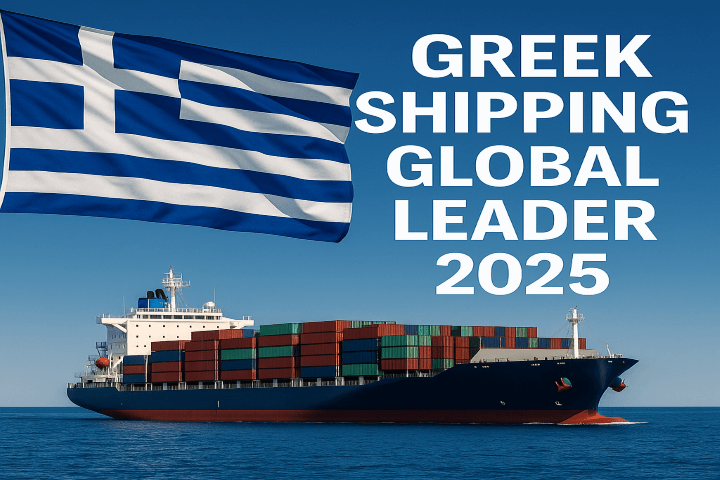
Introduction: Greece’s Unshakable Position in Global Shipping
The latest data from 2024–2025 confirms that Greek shipping has once again secured its title as the global leader. With over 5,691 vessels under management, Greek shipowners control the largest merchant fleet in the world. This leadership is not just a matter of numbers — it reflects Greece’s deep-rooted maritime tradition, strategic positioning in global trade, and resilience in an evolving shipping market.
1. The Numbers Behind the Leadership
According to the report, the Greek fleet represents nearly 20% of global deadweight tonnage (DWT), making it the backbone of international cargo transport. Greek-owned ships dominate in sectors such as:
- Crude oil tankers (over 30% of world capacity),
- Liquefied natural gas (LNG) carriers,
- Bulk carriers (iron ore, coal, and grain transport).
This global dominance underscores the essential role Greece plays in connecting raw materials, energy, and goods across continents.
2. Why Greek Shipping Stays Ahead
Several factors explain why Greek shipping global leader status has remained unchallenged:
- Family-owned businesses: Generational continuity ensures long-term vision and stability.
- Strategic financing: Access to global capital markets and ship financing gives Greek shipowners competitive advantages.
- Flexibility in fleet renewal: Greek companies are quick to modernize fleets to comply with IMO decarbonization and safety standards.
- Geopolitical advantage: Greece’s location at the crossroads of Europe, Asia, and Africa strengthens its relevance in global trade routes.
3. International Implications
The fact that Greece retains its leadership in 2025 carries significant international consequences:
- Energy security: With Greece managing one-third of the global oil tanker fleet, countries rely heavily on Greek shipping for energy imports.
- Climate transition: Greece’s fast adoption of greener ships helps push the entire industry toward sustainability goals.
- Geopolitics: Greece’s strong maritime position enhances its leverage within the European Union and the International Maritime Organization (IMO).
4. Looking Ahead: Challenges and Opportunities
While Greece is in a strong position, challenges remain:
- Decarbonization costs: The transition to alternative fuels (LNG, hydrogen, methanol) requires billions in investment.
- Competition from China and Singapore: Both nations are expanding their fleets and shipbuilding capabilities.
- Geopolitical tensions: Instability in the Red Sea, Black Sea, and South China Sea directly affects shipping routes.
Yet, Greece’s proven adaptability suggests it will not only maintain but potentially expand its leadership role in the coming decade.
Conclusion: Greece at the Helm of Global Trade
The 2025 confirmation of Greek shipping global leader status is more than a national achievement — it is a cornerstone of world trade. Greece’s vast fleet, financial acumen, and strategic adaptability make it indispensable in connecting markets and ensuring energy security. As the maritime industry faces new challenges in decarbonization and digitalization, Greek shipping is poised to remain at the forefront.