
Introduction: Another Wake-Up Call at Sea
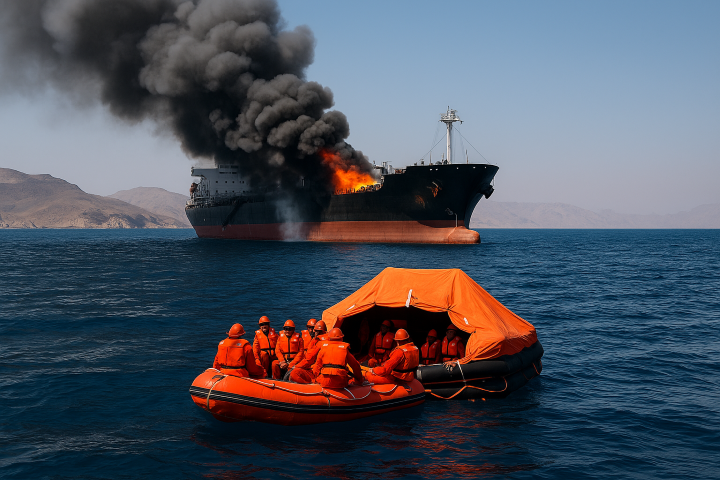
On October 18, 2025, the UKMTO (United Kingdom Maritime Trade Operations) reported that a commercial vessel sailing 116 nautical miles east of Aden, Yemen, was struck by an unidentified projectile. The hit caused a fire onboard, and while no casualties were immediately reported, the vessel sustained damage and was temporarily adrift.
This latest attack in one of the world’s most crucial trade corridors serves as a stark reminder: crew safety, emergency readiness, and certified LSA and FFE systems are not optional—they are life-saving essentials.
1. The Role of LSA and FFE Systems in Emergencies
In incidents like the Aden strike, the first few minutes determine everything. The crew’s ability to react depends directly on the readiness of life-saving appliances (LSA) and fire-fighting equipment (FFE).
- LSA systems such as liferafts, release hooks, rescue boats, and immersion suits must be ready for immediate use.
- FFE systems — fire extinguishers, fixed CO₂ systems, and breathing apparatus — prevent onboard fires from spreading and give the crew valuable time to respond.
Without functioning LSA and FFE systems, an attack or onboard explosion could turn from a manageable emergency into a full-scale tragedy.
2. Legal and Operational Accountability
Under SOLAS, IMO LSA Code, and MSC.402(96), shipowners are legally required to maintain and certify all safety equipment at all times.
Failure to comply can result in:
- Detention by port state control authorities
- Suspension of class certificates and insurance coverage
- Civil and criminal liability in case of injury, loss of life, or pollution
In today’s high-risk regions like the Red Sea and the Gulf of Aden, ensuring maritime safety and LSA FFE systems compliance is not just regulation—it’s risk management.
3. Maintaining LSA and FFE Systems: Safety and Cost Efficiency
Even the best-equipped ships are only as safe as their maintenance schedules. During layovers, anchorage delays, or port congestion, shipowners can use time efficiently by conducting:
- Annual LSA and FFE inspections
- Release hook overhauls
- Hydraulic system maintenance
- Safety certification renewals
Moreover, keeping critical systems such as fire protection and communication systems always operational and properly maintained plays a vital role in minimizing potential material damage during emergencies.
Proactive maintenance doesn’t just protect people—it reduces damage costs and ensures faster recovery when incidents happen.
4. Berth Marine: Reliability When It Matters Most
At Berth Marine, safety is not a service—it’s a commitment. With globally approved expertise in LSA, FFE, and hydraulic systems, we help shipowners stay compliant, prepared, and confident.
Our capabilities include:
- Annual & five-year inspections of LSA and FFE systems
- Hook testing, certification, and repair
- Hydraulic system service and pressure testing
- IMPA-coded spare parts supply with fast global delivery
From the Mediterranean to the Gulf of Aden, Berth Marine supports vessels in meeting international safety standards and minimizing downtime.
5. The Broader Picture: Maritime Security and Readiness
The Aden attack underscores that no sea is completely safe. Modern maritime operations demand not only vigilance but also readiness. A single lapse in safety maintenance can have cascading effects—on human life, cargo, insurance, and even global supply chains.
Regular inspection and certification of LSA and FFE systems are no longer optional—they are core operational necessities that define responsible shipping in the 21st century.
Conclusion: Be Ready Before It Happens
The October 18 2025 Aden Sea incident reminds the maritime world of a simple truth: danger at sea can arise without warning, but preparedness can save lives.
With certified LSA and FFE systems, trained crews, and trusted partners like Berth Marine, shipowners can navigate even the most challenging waters with confidence.
In the maritime industry, readiness isn’t a reaction—it’s a responsibility.