


Here is a question worth asking on board this week: who last load tested the stores crane, and where is the paper? Since 1 January 2026 a SOLAS surveyor can ask it too. That is the practical effect of SOLAS II-1/3-13, which brings most ship lifting appliances and their loose gear under one regime.
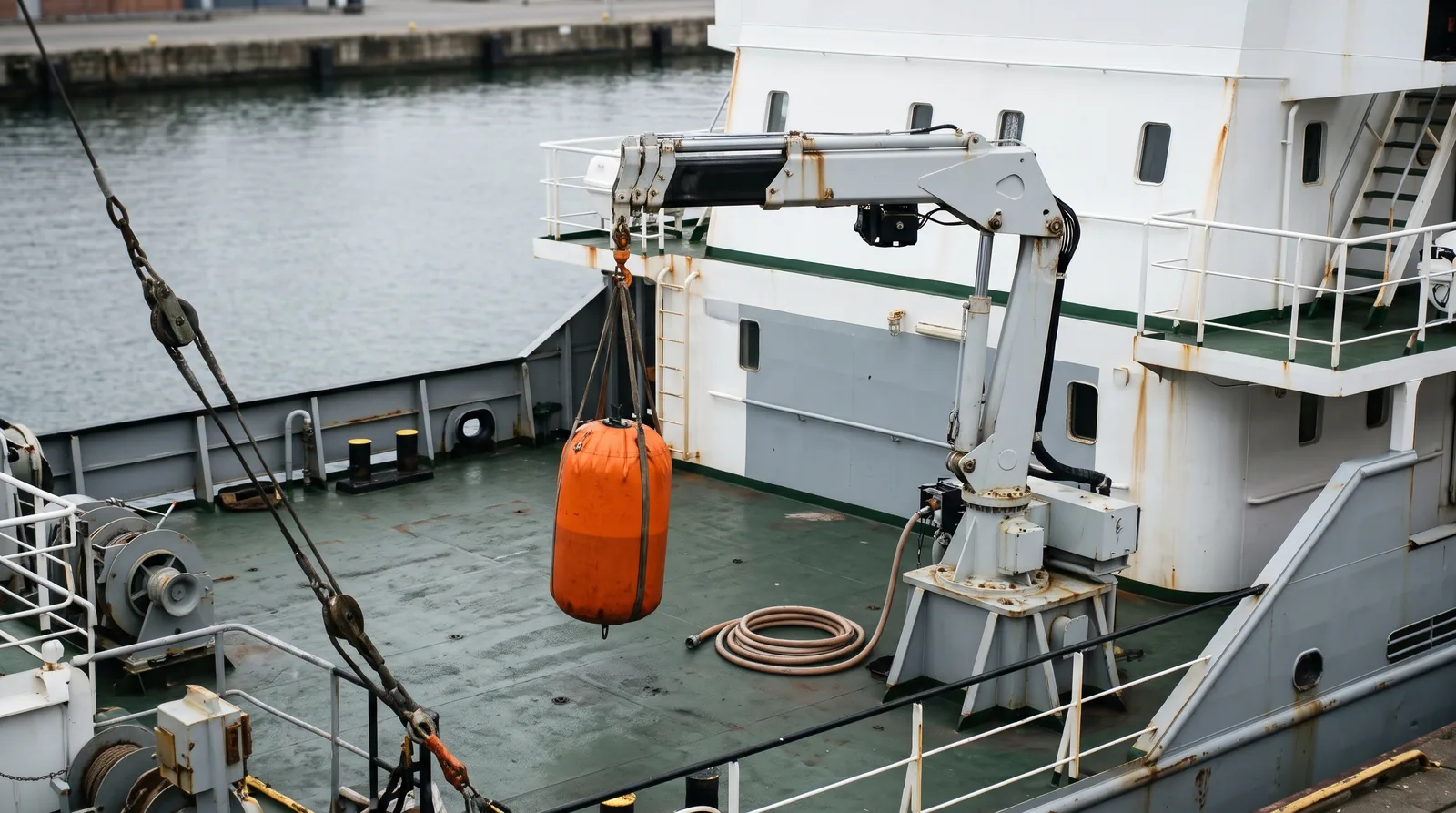
The net is wide. Lloyd’s Register lists cargo, engine room, stores, hose handling, tender launching and personnel handling cranes. The Isle of Man notice revised in June 2026 adds bunker davits, bosun store davits and permanently installed monorail hoists to its examples. It leaves out life-saving launching appliances that comply with the LSA Code, integrated hatch cover machinery and removable or portable cranes. Anchor handling winches fall under the same regulation with separate guidelines, MSC.1/Circ.1662, but Britannia P&I notes they matter only to a specific sector.
Your SOLAS II-1/3-13 deadline depends on your ship
Under SOLAS II-1/3-13, new equipment is the simple case. Anything installed on or after 1 January 2026 needs a load test and a thorough examination before first use. Existing equipment gets more time: the deadline is the first Safety Construction (SAFCON) renewal survey on or after that date. By then you must have tested it, examined it, permanently marked its safe working load (SWL) and documented that SWL.
So there is no single industry deadline. One ship may have a renewal survey next spring, while another on a later cycle may have years. Check the date for each hull.
Before you book anything, look for existing certificates. Valid certificates issued before 1 January 2026 under another instrument acceptable to the flag, such as ILO Convention No. 152, count as compliant according to the Indian Register of Shipping (IRS) and LR. Ships with valid cargo gear certificates may therefore have less to do than expected.
Survey windows need care as well. LR notes that SOLAS does not define them for this purpose. Some flags allow them, others do not, and some authorities and ports may not recognise them. If your plan relies on a window, get the answer from your flag first.
What the surveyor will want to see
According to LR, the first renewal survey after 1 January 2026 verifies five things:
- the appliance is certified to an acceptable standard;
- it is marked with its SWL and other essential operating information;
- loose gear carries a permanent serial number and SWL;
- appliances and loose gear have a load test and thorough examination by a competent person on record;
- an operation and maintenance manual is on board.
Behind all of this sits the Register of Ship’s Lifting Appliances and Cargo Handling Gear, with test and examination certificates attached. If you only open one document before the survey, make it that one.
SOLAS II-1/3-13 test loads, in numbers
After the first test, the rhythm is steady. MSC.1/Circ.1663, the IMO guidelines behind the rule, asks for a load test at least every five years and after repairs or alterations of a major character. A thorough examination follows every load test and repeats annually.
For appliances used in port or sheltered waters, the minimum test loads are:
| Safe working load | Minimum test load | Worked example |
|---|---|---|
| Up to 20 t | 1.25 x SWL | 5 t crane: 6.25 t |
| Over 20 t, up to 50 t | SWL + 5 t | 30 t crane: 35 t |
| Over 50 t | 1.10 x SWL | 60 t crane: 66 t |
Cranes meant for open-sea work are different. The flag or a recognised class society decides their test loads, taking dynamic loads into account. Loose gear has its own table too. Hooks, shackles and chains up to 25 t take 2 x SWL, for instance, and a single sheave block takes 4 x SWL. ABS also lists a corrigendum to the circular (Corr.1), so confirm the figures with your flag or class before you fix a test load.
Four places where this gets awkward
The crane with no papers. The maker went out of business years ago and nobody can prove the SWL. The guidelines allow for this. The company nominates an SWL and works out the test load from that figure, and the flag has to accept it. Choose carefully, because the SWL has to be marked on the crane.
The small crane under 1,000 kg. It is not automatically exempt. SOLAS II-1/3-13 lets each flag decide how far certain requirements apply, and Bureau Veritas reads them as applying unless the flag has decided otherwise. The Isle of Man, for example, keeps these appliances under its older national lifting plant rules for design, construction and installation. So read your own flag’s circular.
The missing manual. Each appliance needs a maintenance manual and an operations manual from the manufacturer. Where those no longer exist for existing equipment, the guidelines allow competent third parties to provide them. That takes time, so start well before the survey.
The bucket of shackles. Loose gear needs a unique identifier, an SWL and evidence of a proof test. Gear that fails the rules must not be used. It should carry a “not to be used” mark, go into a quarantine area and stay in the register until you repair it or dispose of it.
Who is allowed to sign
The guidelines separate two roles. A responsible person, appointed by the master or company, handles maintenance, inspection and operational testing. A competent person must be present for load tests and carries out thorough examinations, and the flag has to accept that person. Before you book anyone for a test, ours included, confirm with your flag or class that they will accept the attendance.
A sensible first step for SOLAS II-1/3-13
Walk the ship with a blank sheet. Write down every crane, davit, hoist and piece of loose gear. Then add the SWL marking, the last test date, the certificate number and the next renewal survey. The gaps will show you what to book first.
Test early if you can. A load test can expose a defect, and a major repair then means another load test. It is better to have that time in hand than to run into it during the survey.
How Berth Marine can help
We carry out crane inspection and repair on board or in port, working from Tuzla, Istanbul. We also run load tests with water weight bags, so the load can be applied without bringing solid test weights on board, and we document the result. If SOLAS II-1/3-13 is on your list before the next survey, send us the vessel name, crane maker and model, SWL, port and dates through our contact page.
This is a general summary, not legal or class advice. Your flag State and class society have the final word on what applies to your ship.
Sources
- IMO MSC.1/Circ.1663: Guidelines for lifting appliances (copy hosted by ABS)
- ABS: SOLAS requirements for lifting appliances and anchor handling winches
- Lloyd’s Register: Class News 12/25
- Isle of Man Ship Registry: Technical Advisory Notice 009-23 (Rev. 3, June 2026)
- Indian Register of Shipping: Technical Circular 026/2025
- Britannia P&I: New SOLAS regulation affecting lifting appliances
- Bureau Veritas: New SOLAS requirements for lifting appliances